









In brief
- Relative humidity (RH) indicates how humid the air is; a healthy level is between 40 and 60%.
- The dew point is the temperature at which moisture in the air condenses, for example on a cold windowpane or thermal bridge.
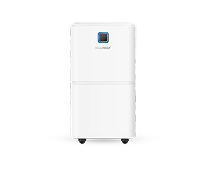
- Capacity is the maximum number of liters of moisture per 24 hours; match it to your room and moisture problem.
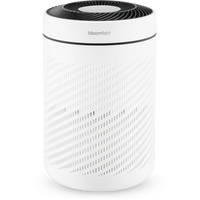
- A HEPA filter is only included in 2-in-1 models and captures up to 99.97% of fine particles from the air.
Anyone buying or using a dehumidifier soon comes across terms such as RH, dew point, capacity, and HEPA. These terms help determine which appliance suits your room, but they are rarely explained clearly. Below, you will find the most important terms relating to moisture and dehumidifiers, each with a short and clear answer.
This is more than theory. Moisture is a real problem: mold occurs in approximately 10% of homes. Once you understand these terms, you can make a better choice and get more from your appliance. Also view the full range of dehumidifiers if you are exploring your options.
What is relative humidity (RH)?
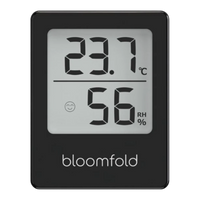
Relative humidity (RH) indicates how much water vapor the air contains compared with the maximum amount possible at that temperature, expressed as a percentage. At 100%, the air is saturated and moisture can condense.
A healthy level indoors is between 40 and 60%, with around 50% being ideal. Above 60%, mold spores have the opportunity to germinate. You measure RH with a hygrometer. Read more about this in our article on ideal humidity.
What is the dew point?
The dew point is the temperature at which the air becomes saturated with water vapor and that moisture begins to condense. At that point, relative humidity is 100%.
You know the effect from glasses fogging up when you enter a warm, humid room: the glass is colder than the dew point, so moisture settles on it. The same thing happens on cold windows at home. If, for example, the temperature is 15 degrees and the dew point is 8 degrees, condensation forms as soon as a surface cools to 8 degrees.
What is a thermal bridge?
A thermal bridge is a place in a structure where the insulation is interrupted, making the surface locally colder than the rest of the wall. Examples include the transition between a wall and floor, window frames, or corners.
Because such a surface is colder, it reaches the dew point sooner. Warm indoor air that touches it cools down and settles as moisture. This explains recurring mold in a corner or behind a cabinet. A dehumidifier lowers the humidity, but the thermal bridge itself must be addressed with insulation.
What does the capacity of a dehumidifier mean?
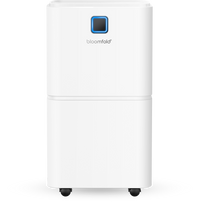
Capacity is the maximum number of liters of moisture that a dehumidifier extracts from the air per 24 hours, for example 12, 16, 20, or 25 liters per day. This is a maximum under favorable conditions, not a fixed daily result.
Bigger is not automatically better. Choose the capacity based on the room size and the severity of the moisture problem, rather than automatically choosing the largest model. An appliance that is too large costs unnecessarily much, while one that is too small cannot keep up. View the range of dehumidifiers to compare capacities.
What is a HEPA filter?
An H13 HEPA filter captures up to 99.97% of fine particles from the air, such as pollen, dust, and allergens. This standard applies to particles measuring 0.3 microns, precisely the size that is most difficult to capture.
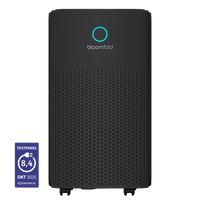
Important: not every dehumidifier has a HEPA filter. Only the 2-in-1 models that also purify the air have one. When purchasing, check the EN 1822 classification (H13 or H14), as terms such as "HEPA-type" do not meet this standard.
What is a carbon filter?
A carbon filter absorbs odors and gases that a HEPA filter does not stop. The activated carbon binds odor molecules and retains them.
A HEPA filter and a carbon filter complement each other: one captures particles, while the other removes odors. The carbon filter is also included in the 2-in-1 models and becomes saturated over time, after which you replace it.
What is a condensation dehumidifier?
A condensation dehumidifier cools the intake air so that the moisture condenses and flows into the reservoir. The drier air is then slightly warmed and blown back into the room.
This type works better as the air gets warmer, because moisture condenses more easily. For good results, make sure the room is at room temperature. It is the most common type of dehumidifier for ordinary living spaces.
What is a humidistat?
A humidistat is the built-in sensor that automatically switches the dehumidifier on and off at the set humidity level. For example, if you set it to 50%, the appliance runs until that level is reached and then switches off.
This saves electricity and reduces wear, because the appliance only runs when necessary. It works similarly to a thermostat, but for humidity instead of temperature.
What is the laundry-drying function on a dehumidifier?
The laundry-drying function is the continuous mode (CNT), in which the appliance keeps extracting moisture nonstop until you switch it off or the reservoir is full. In this mode, the appliance ignores the set humidity level and simply continues running.
Depending on the model, you will see a T-shirt icon or the message "CNT" on the display; you activate it with the MODE button. It is useful when drying laundry indoors and wanting to keep the room dry quickly.
What does the IPX rating mean?
The IPX rating indicates how well an appliance is protected against water. The number after the X ranges from protection against splashing water to immersion: the higher the number, the more resistant it is to moisture.
This is particularly important in humid rooms such as the bathroom. An ordinary dehumidifier is not splashproof or waterproof, so always place it in a dry, stable location outside the wet zone, away from the shower, bath, and sink.
From understanding to making the right choice
Once you know these terms, you can read product pages and advice articles with greater understanding. You know what capacity means, why RH and dew point are related, and which filters are only included in the 2-in-1 models.
If you are unsure which model suits your room, take the selection guide for tailored advice based on your room and moisture problem.


Leave a comment