









In brief
- The CADR rating is the amount of clean air an air purifier delivers per hour, measured in cubic meters per hour.
- It is the only number that lets you fairly compare air purifiers by speed.
- For a typical living space, aim for at least four to five air changes per hour.
- Quick rule of thumb: the CADR rating multiplied by 0.12 gives the suitable area in square meters.
- Manufacturers often state the CADR rating at the highest, loudest setting, so choose a slightly larger model if you want to use a quiet setting.
The CADR rating is the only number that lets you fairly compare air purifiers. Other specifications tell you something about the device, but the CADR rating tells you something about the result: how much clean air you actually get per hour. Once you understand this number, you can choose an air purifier based on capacity rather than intuition.
Below, you’ll read exactly what the CADR rating is, how much you need for your space, and how to calculate it yourself. Also view the air purifiers range if cleaner air at home is important to you.
What is the CADR rating?
The CADR rating (Clean Air Delivery Rate) is the amount of clean air an air purifier delivers per hour, expressed in cubic meters per hour. The figure comes from a standardized test by the Association of Home Appliance Manufacturers, which measures performance against three types of particles: dust, pollen, and smoke.
As a result, a device often has three CADR ratings, one for each type of particle. The higher the rating, the faster the purifier removes those particles from the air. It is a measurement, not a marketing figure, and that is precisely why it is useful for comparing models.
Why is the CADR rating important?
The CADR rating determines whether an air purifier keeps your space clean quickly enough or is constantly trying to catch up. A rating that is too low for a large space means that particles settle more slowly than they are replenished, and you will notice little difference.
The rating translates into air changes per hour: how often the entire volume of a room passes through the filter each hour. Researchers at the Harvard T.H. Chan School of Public Health use a target of at least five air changes per hour, meaning the air is fully filtered approximately once every twelve minutes. The right CADR rating is exactly what makes that possible.
How many air changes per hour do you need?
For a typical living space, aim for at least four to five air changes per hour. That is the guideline followed by health authorities such as the U.S. EPA and Harvard researchers for good indoor air quality.
If you are dealing with pollen, pets, or a lot of cooking, more is better, and you can aim for six to eight air changes. More air changes mean that airborne particles pass through the filter more often before settling or being inhaled again. For most households, four to five is a solid starting point.
How to calculate the CADR rating for your space
The calculation takes two steps. First, determine the volume of your space, then multiply it by the number of air changes you want.
Step one: area multiplied by ceiling height gives you the volume. A living room of 30 m2 with a 2.5-meter ceiling has a volume of 75 cubic meters.
Step two: volume multiplied by the desired number of air changes gives you the required CADR rating. For five air changes, calculate 75 multiplied by 5, which comes to 375 cubic meters per hour. For that living room, you should therefore look for an air purifier with a CADR rating of around 375 m3 per hour.
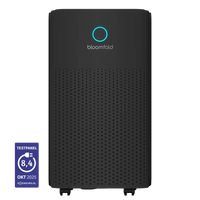
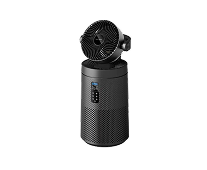
Want to calculate it faster? Use the rule of thumb: the CADR rating multiplied by 0.12 gives the suitable area in square meters. The Cyclone delivers 400 m3 per hour; multiplied by 0.12, that is approximately 48 m2, which matches the stated coverage of up to approximately 50 m2.
Which CADR rating is suitable for which space?
As a rule of thumb, a CADR rating of around 250 m3 per hour suits a space of up to approximately 25 m2, while around 400 m3 per hour suits spaces of up to approximately 50 m2. This is how the figure translates into practice:
- Bedroom or study (up to approximately 25 m2): a CADR rating of around 250 m3 per hour, such as the Whisper delivers.
- Living room or open space (up to approximately 50 m2): a CADR rating of around 400 m3 per hour, such as the Cyclone delivers.
- Large or interconnected open spaces: consider a higher rating or two devices that together reach the required CADR rating.
For each model, check which capacity suits your space.
What should you consider besides the CADR rating?
In addition to the CADR rating, consider the setting you will actually use, because manufacturers often state the figure at the highest and therefore loudest setting. At a quiet night setting, the actual CADR rating is lower, meaning you achieve fewer air changes than the figure on the box suggests.
The practical solution is to choose a slightly larger model than the minimum. With some extra capacity, you can still achieve enough air changes at a low setting. Also pay attention to the filter type: all models use an H13 HEPA filter, which captures up to 99.97% of particles such as pollen, dust, and allergens from the air. If you want to know exactly what happens inside the filter, read what an air purifier does.
Calculate using your own space
The CADR rating turns an invisible promise into a measurable figure. Measure your space, choose the number of air changes that suits your situation, and calculate the required rating. Then choose a model slightly above the strict minimum, so you retain enough capacity even at a quiet setting.
Not sure which model suits your space? Read the explanation about air purifiers or view the full range.


Leave a comment