









In short
Which dehumidifier you need depends on two things: the size of the room and how serious the moisture problem is. Not on how large the appliance is. As a rule of thumb, up to about 10 to 12 liters per day is suitable for a small room, 12 to 16 liters for an average living room, and 20 liters or more for a basement, laundry room, or persistent dampness. A dehumidifier that is too large uses unnecessary electricity, while one that is too small runs itself ragged without reaching the desired level. The right size is the economical size. Look for a built-in humidistat so the appliance stops automatically once the set humidity level is reached.
Before people buy a dehumidifier, they almost all ask the same question: which dehumidifier do I need? It is the most frequently asked question received by our customer service, and the answer is less complicated than most product lists suggest.
It comes down to two things. How large is the room, and how serious is the moisture problem? Once you have clarified those two points, the choice almost makes itself. In this article, we go through it step by step, from capacity to the approach for each room.
Which dehumidifier do you need?
Choose the capacity that suits the size of your room and your moisture problem, not the largest unit you can find. That is the whole idea, and it saves you money and hassle.
Two variables determine the choice. The first is the size of the room in square meters. The second is the severity of the moisture problem: light condensation on the windows in the morning is different from a basement with wet walls. A larger room or a more serious moisture problem requires greater capacity. In this case, more is not better, but more suitable.
Many people think it is safer to immediately choose the largest model. That is a misconception that costs more money than it solves problems. Further on, we explain why.
What does capacity mean for a dehumidifier?
Capacity is the number of liters of moisture an appliance removes from the air per day, not the size of the water reservoir. So a 12-liter model can remove up to 12 liters of moisture per day, while the water tank often holds only a few liters.
Important to know: the stated litre figures apply under test conditions. Manufacturers usually measure in a warm, humid environment of around 30 degrees and 80 percent humidity. An average Dutch home is cooler and drier, so in practice you will achieve a lower output than the number on the box. Therefore, treat the stated capacity as an upper limit, not a daily guarantee.
That is precisely why the capacity you choose matters so much. Base your calculation on what you actually achieve at home, not on the laboratory rating.
Which capacity is right for which room?
As a rule of thumb, up to approximately 10 litres per day is suitable for a small room, 10 to 20 litres for a medium-sized room, and 20 litres or more for a large or very damp room. The Consumers' Association uses similar guidelines based on floor area: up to 10 litres per day for 15 to 25 square metres, 10 to 20 litres for 25 to 45 square metres, and 20 to 30 litres for larger rooms.
Our dehumidifiers range from 12 to 25 litres per day. This is how you match the rule of thumb to the right range:
| Room or situation | Rule-of-thumb capacity | Suitable range |
|---|---|---|
| Bedroom, small room, light condensation | up to approximately 12 litres per day | 12L |
| Living room, average moisture problem | approximately 12 to 16 litres per day | 12L or 16L |
| Larger living space or attic | approximately 16 to 20 litres per day | 16L or 20L |
| Basement, laundry room, persistent damp | 20 litres per day or more | 20L or 25L |
If you are unsure between two classes, choose the larger one. An appliance that can handle slightly more reaches the desired level faster and then needs to run for less time.
Why is bigger-is-better an expensive mistake?
An oversized dehumidifier uses unnecessary electricity, while an undersized one works itself ragged without reaching the desired level. Choosing the right size is therefore not just a matter of results, but also of your energy bill.
Dehumidifiers consume relatively much electricity. An entry-level model uses between 200 and 400 watts, while a medium-sized model can use as much as 400 to 600 watts. If a powerful appliance runs at full capacity in a room that does not need it, you pay for capacity you do not use. Read more about consumption and costs in our article on dehumidifier electricity consumption.
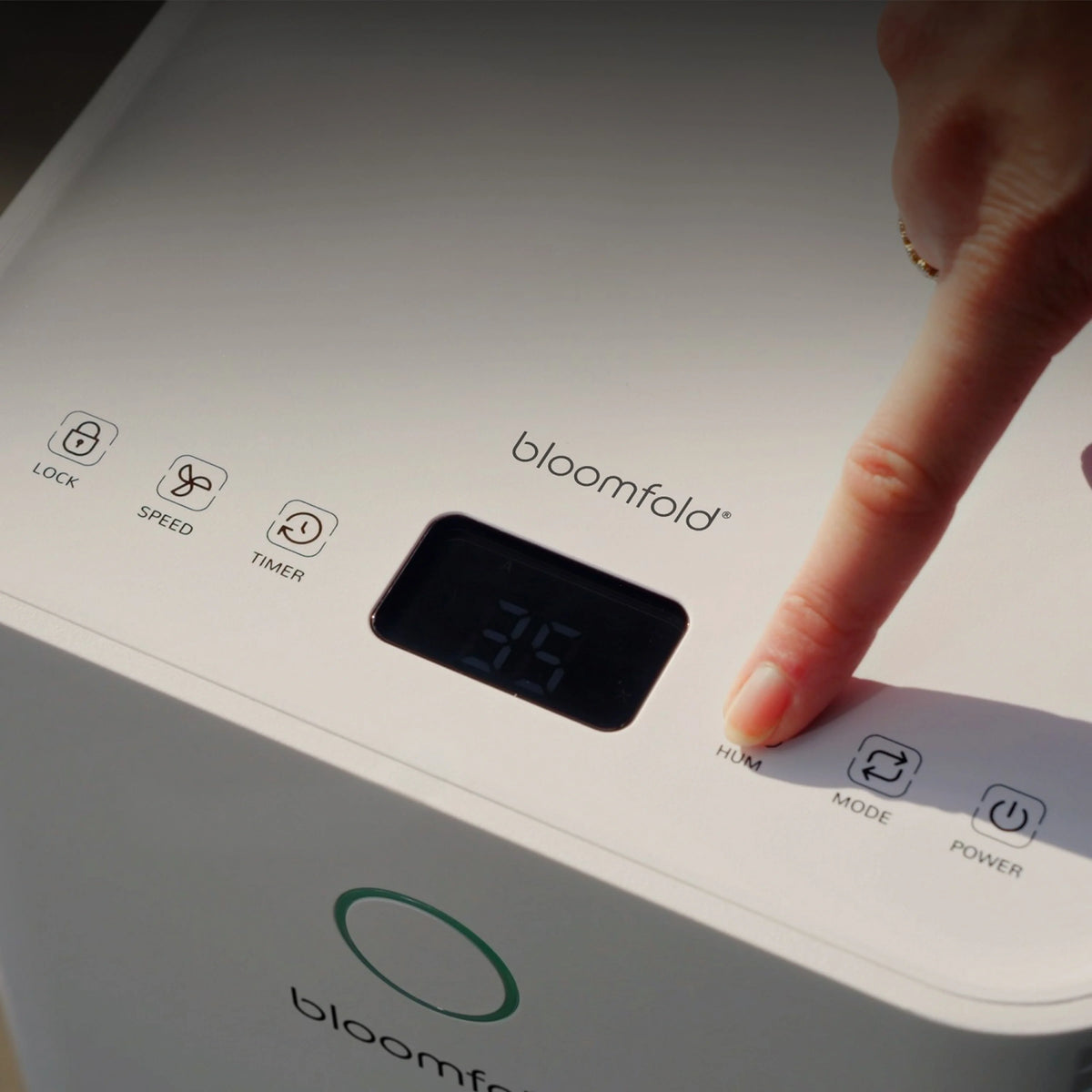
The smartest savings come from the controls. Choose a model with a built-in humidistat that measures the humidity and automatically switches the appliance off once the target is reached. This prevents it from running unnecessarily. A properly adjusted dehumidifier runs for less time and therefore uses less energy.
How do you choose for each room? From bedroom to basement
The rule of thumb is a starting point, but every room has its own consideration. Below are the most common situations.
In the bedroom, comfort matters just as much as capacity. You want a model that runs quietly and automatically keeps the humidity at the right level while you sleep. A 12L model is often more than sufficient here. View the options in the collection for the bedroom.
The living room is usually an average case: fogged-up windows in the morning and an occasionally clammy atmosphere. A 12L or 16L model is a good fit here, depending on the area and how open the space is.
The basement is a different story. Basements are often colder and consistently more humid, and it is no coincidence that they are where most people buy a dehumidifier for. Choose a more powerful model of 20 liters or more here. With persistent humidity, continuous mode is useful: the appliance continues extracting moisture until the tank is full or you switch it off. For suitable models, see the collection for the basement.
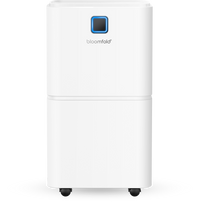
The right choice in practice is clearly illustrated by a customer who placed the Halo 12L in the living room. The humidity there consistently rose to 78 to 80 percent and started to feel unpleasant. Within a week, the room was around 51 percent. At night, it rose somewhat to 62 percent, only to drop back to 51 after running for a few hours. Choosing a suitable model instead of the largest appliance was exactly enough here.
Why does the right humidity matter?
A good reason not to simply buy the most powerful device: the goal is not to make the air as dry as possible, but to maintain a healthy range. Humidity between 40 and 60 percent, with around 50 percent as ideal, keeps the air comfortable and gives mold and dust mites little opportunity to thrive.
If you consistently fall below 40 percent, the air becomes too dry. If you remain above 60 percent for an extended period, it becomes too humid. The RIVM points out that damp living conditions and mold increase the risk of respiratory complaints, and that moisture problems often arise from cooking and showering combined with insufficient ventilation. Moisture and mold problems are also more common in older homes built before 1992.
A dehumidifier helps keep humidity within that range, but it is about balance. A home that is too dry can also cause problems. You can read more about the target values in our article on ideal humidity. If you have persistent health complaints, consult a general practitioner or specialist.
What does choosing really come down to?
Choose based on the room and moisture problem, look for a humidistat, and opt for something slightly larger rather than too small. That is the whole decision, summed up in one sentence.
A short checklist to keep in mind:
- Measure or estimate the room's area in square meters.
- Determine how severe the moisture problem is: light condensation, moderate, or persistent moisture with mold or wet walls.
- Match the capacity to those two factors, using the table above as a guide.
- If you are undecided between two classes, choose the larger one.
- Check whether the model has a humidistat for automatic control.
Still not sure which size best suits your situation after all this? Our selection guide asks a few short questions and points you to the right model.
Ultimately, the best dehumidifier is not the largest or most expensive, but the size that suits your space and your moisture problem. Choose based on that, and you will have a device that works efficiently and does not use more electricity than necessary.



Leave a comment