









In brief
- A self-emptying station automatically empties the robot's dustbin, so you don't have to do it manually after every cleaning session.
- The biggest benefits are saving time and having less contact with dust.
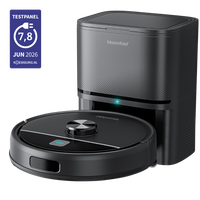
- At Bloomfold, the Drift has a self-emptying station with a 3-liter dust bag that requires no maintenance for up to twelve weeks, while the Sweep has a bin that you empty yourself.
- For households with pets, allergies, or a busy family, a self-emptying station offers the greatest benefit.
- If you live in a small home, don't have pets, and don't mind emptying a bin occasionally, a self-emptying station is a convenient extra, not a necessity.
What exactly is a self-emptying station?
A self-emptying station automatically empties the robot vacuum's dustbin as soon as it has finished a cleaning session. Instead of emptying the robot's bin by hand, the station transfers its contents to a larger collection bag or bin inside the station itself. This means you only need to deal with emptying it after a longer period, rather than after every session.
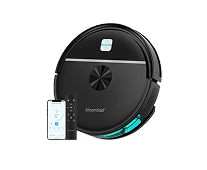
Bloomfold offers two different solutions here. The Drift has a self-emptying All-in-Home Station that transfers the dust after each cleaning session to a 3-liter dust bag in the station, requiring no maintenance for up to twelve weeks. The Sweep does not have a self-emptying station: you empty its bin yourself after a session, or more often if you live in a smaller home and the bin fills up faster.
View the full range in the robot vacuums collection.
What are the benefits of a self-emptying station?
The biggest benefit is saving time: you don't have to empty the dustbin yourself after every cleaning session. Consumer Reports explicitly mentions this in its test of robot vacuums for pet owners as a benefit for people who vacuum regularly, for example because of shedding pet hair.
A second benefit is less direct contact with dust. Because the dust ends up in a sealed bag instead of an open bin that you empty yourself, you come into less contact with fine dust and allergens. In its test of robot vacuums for pet owners, Forbes highlights this hygiene aspect as a relevant argument for households with allergy sufferers.
Finally, the robot's suction power remains more consistent because a full dustbin no longer restricts airflow during the cleaning session.
What are the disadvantages of a self-emptying station?
The main disadvantage is noise. Emptying the bin produces a short, distinctive sound, similar to a brief burst of powerful suction. Independent research by CNET, cited by Housekeeping WonderHowTo, confirms that emptying a station is generally louder than the robot itself while vacuuming. If your station is in a living room or bedroom, you'll notice it.
A second disadvantage is the space the station takes up. A self-emptying station is considerably larger than a regular charging station, simply because it needs to accommodate a collection bag or bin. In a small home, that can be a real consideration.
Finally, a self-emptying station still requires maintenance. Filters need to be cleaned or replaced periodically, and a clogged or dirty station can negatively affect the robot's suction power and navigation. A self-emptying station means less frequent attention to emptying, not zero maintenance.
How often do you need to empty the station or bin?
Thanks to the 3-liter dust bag in the All-in-Home Station, you don't need to worry about emptying the Drift for up to twelve weeks. With the Sweep, you empty the bin yourself after a cleaning session, or more often if you live in a smaller home and the bin fills up faster.
Both bag-based and bagless self-emptying stations are available on the market. Yahoo Tech points out that bag-based systems generally have somewhat higher ongoing costs than bagless variants, while bagless systems need to be emptied by hand more often than a bag-based system. With Bloomfold's Drift, a replacement dust bag lasts a long time and does not need to be replaced after every cleaning session. View the replacement dust bags in the parts collection for the Drift.
Who would benefit from a self-emptying station?
The best way to determine this for yourself is to turn the question around. How often would you need to empty the dustbin by hand without a self-emptying station, and how much would that actually bother you? This framework, taken from an independent buying guide on The Best Robot Vacuum, works better than simply considering what feels "premium."
Households with pets usually reach an answer quickly: lots of shedding hair means a dustbin fills up faster, and therefore needs to be emptied more often without a self-emptying station. The same applies to larger households, families with children, or homes with lots of carpet, where more dust and dirt is collected. Anyone sensitive to dust or allergies also benefits from the fact that the dust remains in a sealed bag instead of having to open the bin themselves.
Who can manage perfectly well without a self-emptying station?
If you live in a small home, don't have pets, and don't mind emptying a bin now and then, a self-emptying station is a convenient extra but not a necessity. In a studio or small apartment with little dust, emptying a bin usually takes only a few seconds, and it simply doesn't need to be done very often.
For these situations, the Sweep, with its manually emptied bin, is an excellent choice without compromising on suction power or ease of use.
How do you decide what is right for your situation?
There is no right or wrong answer, only an answer that suits your household. If you have pets, a busy family, or feel that you would otherwise be dealing with a bin every day, a self-emptying station like the one on the Drift offers real time savings. If you live in a small, quiet home, the Sweep's bin is an equally pleasant and simpler solution.
Still unsure which model suits you? The product quiz will help you get started with a few questions.


Leave a comment